The world of artificial intelligence (AI) is in constant motion, with new developments emerging at a rapid pace. For business leaders and technical decision-makers, keeping track of the most impactful news from the past week is essential for strategic planning and maintaining a competitive edge. This article recaps key AI developments from the last week, translating these advancements into practical implications for your business automation and intelligent system development roadmap.
This Week's Top AI News: Shaping Your Strategy
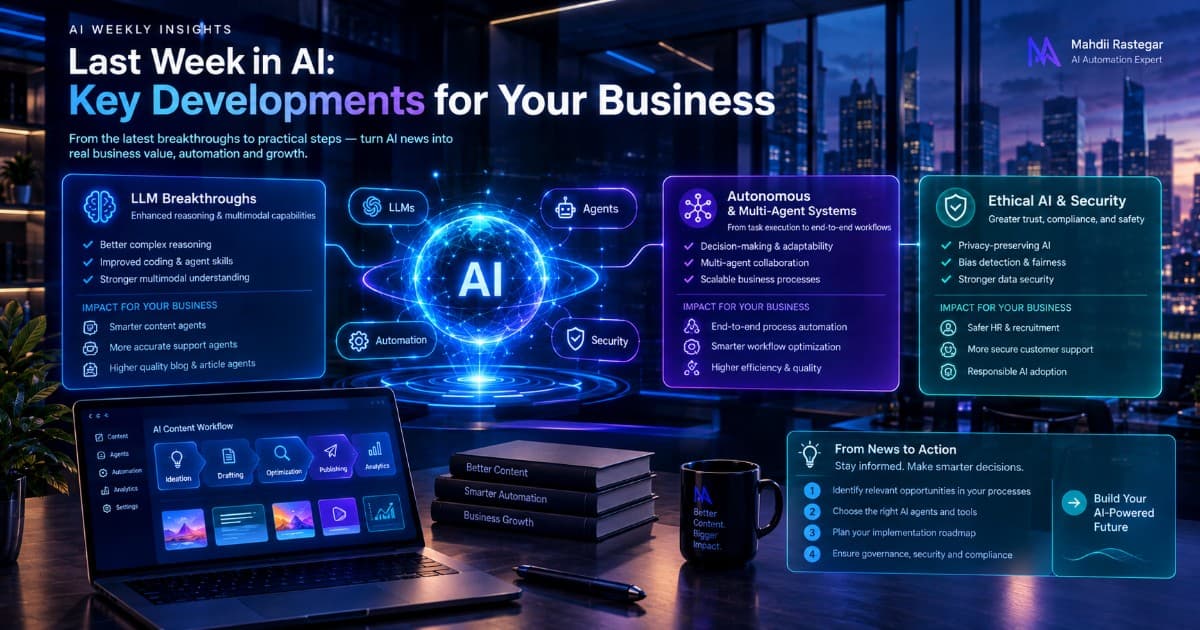
Understanding the latest AI breakthroughs means knowing not just what new capabilities exist, but how they can refine or expand existing AI applications and enable new ones. This past week has brought significant updates across large language models, autonomous agents, and ethical AI deployment. These developments offer fresh opportunities to enhance efficiency and innovation within your organization.
LLM Breakthroughs: Enhanced Reasoning and Application
This past week, new research and industry announcements highlighted significant advancements in Large Language Models (LLMs). Reports emerged demonstrating enhanced performance in reasoning, coding, agent capabilities, and multimodal understanding, particularly in models like Qwen3.5-Plus. Furthermore, developments in models such as Gemini 3.1 Pro showcased a continued focus on complex reasoning capabilities13.
LLMs are advanced AI systems designed to understand, interpret, and generate human language, trained on vast amounts of text data5. They excel at recognizing linguistic patterns, answering questions, drafting content, summarizing information, and engaging in natural conversations5. While popularized by ChatGPT, LLMs are now the engine for many cutting-edge applications across sectors like customer support, education, finance, healthcare, and technology [5, 6].
Impact on AI Content Agents
The enhanced reasoning and generation capabilities reported this week directly translate to more sophisticated content creation. AI Content Agents can now produce coherent, contextually relevant text that adheres more closely to specific brand voices. This means a broader range of content types, from social media captions to long-form articles, can be generated with higher quality and consistency. The improved ability of LLMs to grasp intricate reasoning13 allows content agents to develop compelling narratives, ensuring brand messaging resonates deeply across all channels.
Strengthening AI Support Agents
For customer service, the latest LLM advancements mean AI Support Agents can offer more empathetic and accurate interactions. They are now better equipped to interpret nuanced customer queries, including those with emotional cues or technical details, and provide precise responses. This reduces the need for human escalation, improving resolution rates and customer satisfaction. LLMs can power customer service chatbots and provide customer sentiment analysis, enabling more effective and personalized support6.
Optimizing AI Blog & Article Agents
New insights this week into LLM capabilities significantly benefit AI Blog & Article Agents. These agents can perform more in-depth research, develop strategic content plans, and optimize articles for SEO with greater precision. The quality and relevance of published articles improve, ensuring they are well-written, informative, and tailored to reader intent. This streamlines content production from ideation to publication, leading to higher volumes of high-quality, SEO-optimized content.
Autonomous and Multi-Agent Systems: Scaling Intelligence
This past week, discussions in the AI community emphasized the accelerating evolution of autonomous agents. These intelligent systems are increasingly managing entire workflows independently, shifting beyond simple task execution8. This allows for more complex, end-to-end automation with reduced human oversight. Autonomous agents can operate alone or collaborate in multi-agent systems, enabling organizations to scale decision-making and efficiency [8, 9].
Autonomous agents differ from traditional automation through their capacity to make decisions, adapt to changing conditions, and manage entire processes rather than just executing predefined steps. A single autonomous agent can handle a goal end-to-end for well-bounded tasks9.
For complex processes, multi-agent systems (MAS) are gaining traction. Recent reports highlighted MAS as networks of intelligent software agents that work together across enterprise systems and departments without human involvement10. Operating like teams, MAS share information, delegate tasks, and make collaborative decisions10. They are considered a core building block of the autonomous enterprise10, with agentic AI enabling contextual intelligence beyond rigid, rule-based execution10. Multi-agent systems coordinate multiple specialized agents that share context, hand off work, and parallelize steps to increase speed and quality9.
Revolutionizing Business Process Automation
The advancements in autonomous agents observed this week mean businesses can automate more intricate processes, leading to significant gains in efficiency, throughput, and quality, alongside potential labor cost savings4. Autonomous agents can manage entire workflows, from data intake to decision-making and execution. For example, AI-supported predictive maintenance in manufacturing can prevent costly stoppages by identifying failing parts proactively3. One AI implementation even led to 26% fewer fleet accidents and a 20% increase in operational performance3. However, deploying agents at scale requires a fundamental shift in how businesses think about process architecture and governance2. Challenges for agentic systems include reliability issues, coordination complexities, and scalability constraints12. The most successful deployments pair capable models with the right tools, policies, and human oversight9.
Optimizing AI Workflow Automation
New insights this week into agent autonomy allow for more dynamic workflow adjustments based on real-time data and outcomes. AI Workflow Automation systems can choose the next step in a process based on current data analysis, making workflows more resilient and efficient. For example, an agent could re-route a customer query based on real-time sentiment analysis or adjust supply chain logistics based on immediate market changes. Adaptive AI agents learn from experience, refine operations, and adapt to changing environments without explicit reprogramming11.
The Power of Multi-Agent Systems
This week's discussions reinforced the significant impact of multi-agent systems for complex business challenges. Specialized agents working in concert can tackle tasks that a single agent cannot, reviewing each other's output and handling sequential or parallel operations more effectively. This is vital in areas like supply chain management, where agents can optimize inventory, logistics, and supplier interactions. The highest-value implementations often combine two or more agent types into orchestrated workflows rather than deploying a single agent in isolation11. Multi-agent systems can optimize outcomes across entire organizations, leading to self-organizing supply chains, adaptive financial systems, and dynamic service delivery models8.
Ethical AI and Security: Latest News
New reports this past week highlighted the ongoing focus within LLM research on advancing techniques to tackle data privacy concerns, enhance security, and address ethical considerations like bias and fairness7. This includes developments in privacy-preserving AI, robust AI security measures, and new regulatory frameworks designed to ensure responsible AI deployment.
Building Trust in AI HR and Recruitment Agents
For sensitive applications like AI HR Agents and AI Recruitment Agents, improved privacy and ethical guidelines are paramount. New advancements help ensure fairness in candidate screening, protect employee data, and maintain compliance with regulations. For example, an agent named Klara reviews contracts against an organization’s governance playbook, and another, Susan, handles PII redaction before sensitive data reaches a model3. These capabilities build trust among employees and candidates by guaranteeing data protection and unbiased processes.
Securing Customer Support Automation
Customer Support Automation systems handle vast amounts of personal and sensitive customer data. New security features and privacy standards are essential to protect this information more effectively, enhancing customer trust and ensuring regulatory compliance. This includes advancements in data anonymization, secure data handling protocols, and robust cybersecurity measures to prevent breaches. Such developments enable businesses to offer 24/7 support across multiple channels with confidence in their data protection.
Ensuring Responsible AI Adoption
Implementing these advancements is crucial for a sustainable AI strategy. Beyond compliance, a focus on ethical AI deployment prevents reputational damage and fosters long-term trust with stakeholders. This involves transparent AI systems, bias detection and mitigation, and robust audit trails for AI-driven decisions. As AI becomes more integrated into core business functions, responsible adoption ensures that the technology serves human values and organizational goals without inadvertently creating new risks. Businesses must also be aware that LLMs still face challenges such as ethical concerns and biases in training data7.
Translating This Week's News into Your Automation Roadmap
Staying informed about the latest AI breakthroughs, such as those from the past week, is the essential first step, but strategic implementation is key to unlocking their true value. The rapid pace of AI development, from advanced LLMs to sophisticated multi-agent systems, offers unprecedented opportunities for business transformation.
A tailored approach to AI adoption is crucial. Generic solutions rarely fit the unique needs and existing infrastructure of every business. Instead, focus on evaluating your current manual processes to identify specific areas where these new AI capabilities can deliver the most significant impact. Consider which routine tasks intelligent automation can take over, allowing your staff to focus on strategic initiatives and critical judgment calls3.
The path to integrating these intelligent systems can be complex, involving architectural changes and governance considerations2. Expert guidance can help navigate these complexities, ensuring that your AI strategy is robust, compliant, and aligned with your long-term business objectives.
Your next intelligent business system could start here. Contact us to discuss how these latest AI advancements can be strategically integrated into your specific business processes, leveraging specialized AI agents and automation solutions to drive efficiency and growth.