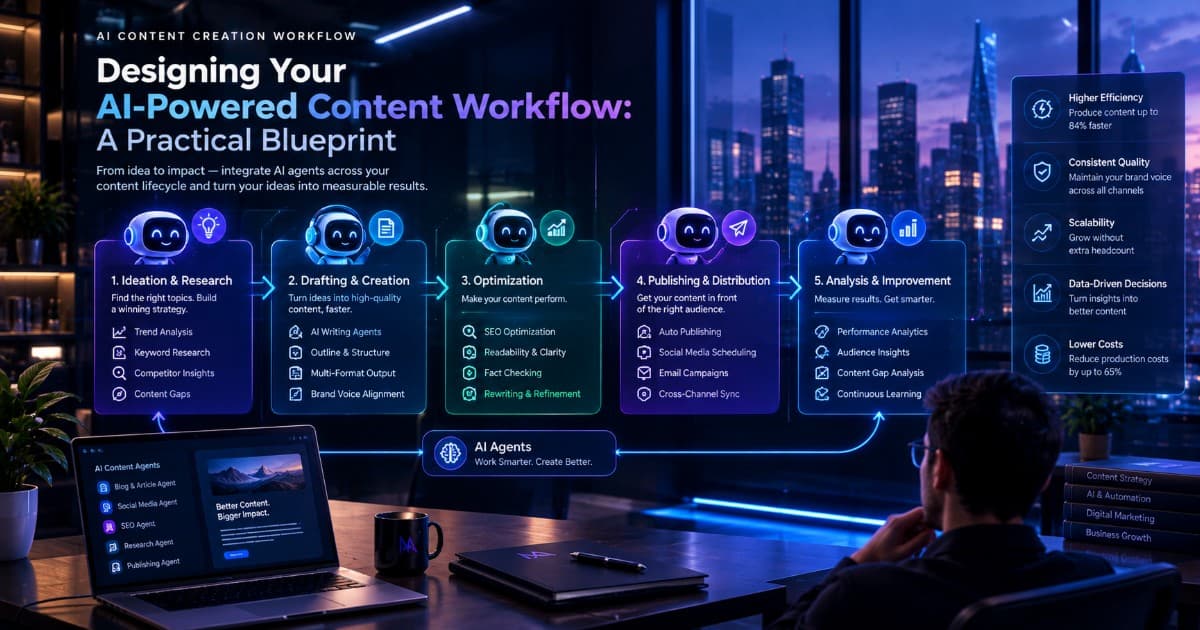
Integrating artificial intelligence into your content operations can transform how your team plans, creates, and distributes material. This guide outlines a practical blueprint for an AI content creation workflow, moving beyond basic generative text to a system where AI augments every stage of content production. You will learn how specialized AI agents can streamline processes, enhance consistency, and free your team to focus on strategic decisions and creative endeavors.
Why Integrate AI into Your Content Workflow?
An AI-powered content workflow is more than just using a tool to generate text; it involves a structured approach where AI agents are integrated into various stages of your content lifecycle, from ideation to publishing and analysis. This approach leverages AI to handle repetitive, data-intensive, or scale-demanding tasks, creating a more efficient and effective content pipeline.
The benefits of integrating AI into content operations are significant and measurable:
- Increased Efficiency and Speed: AI-powered teams can deliver content 84% faster than traditional workflows, which is especially beneficial for product launches and time-sensitive campaigns1. Users of AI tools report an 88% increase in efficiency in content production1, and marketers using AI save an average of 5+ hours per week4. Teams with clear workflows that integrate AI see double-digit gains in speed5.
- Consistency and Quality: AI can ensure brand voice and tone consistency across all content, reducing manual review time and maintaining a unified message.
- Scalability: AI enables businesses to scale content production without proportionally increasing human resources, allowing for broader market reach and more frequent engagement.
- Data-Driven Decisions: AI excels at analyzing vast datasets to identify trends, optimize content for performance, and provide actionable insights for future strategy. AI-driven content is 25% more likely to succeed4.
- Cost Reduction: AI-generated content can reduce production costs by up to 65%12.
It is important to set clear expectations: AI serves as an augmentation tool. It enhances human capabilities but does not fully replace the need for human creativity, strategic oversight, and ethical judgment. AI marketing initiatives can deliver exceptional return on investment (ROI) when properly implemented and measured3, with AI marketing ROI typically stemming from improving the workflow around repeatable marketing tasks, rather than from isolated content generation5. The AI in marketing market is projected to reach $82.23 billion by 2030, with nearly 60% of organizations planning to increase their spending on AI in 20254.
Understanding the Role of AI Content Agents
General-purpose AI tools offer various functionalities, but specialized AI content agents and AI blog & article agents are designed to manage the entire content process. These intelligent systems go beyond simple text generation by connecting to your existing systems, understanding your brand voice, and ensuring output alignment across various channels.
- AI Content Agents are systems that manage the social media content process from ideation and writing to captions, hashtagging, and publishing. They ensure the output aligns with your brand identity across channels.
- AI Blog & Article Agents manage the production of SEO-optimized blog posts and articles. This includes finding ideas, developing a content strategy, conducting research, writing, optimizing for SEO, and publishing. They also support review, improvement, and development after publication.
These agents are built to handle a comprehensive set of tasks, integrating capabilities such as planning, drafting, repurposing, and optimizing content across various formats, including blog posts, social media, email, ad copy, and video scripts6. They can assist writers with idea generation, outline creation, writing first drafts, grammar correction, rephrasing, and SEO optimization7.
Phase 1: AI-Assisted Content Ideation, Strategy, and Research
The initial phase of any content creation workflow involves identifying what to create and why. Here, AI agents can provide a data-driven foundation for your content strategy.
- Topic Identification and Strategy Development: AI agents can analyze market trends, search data, and competitor content to pinpoint high-potential topics and content gaps. For instance, generative AI tools like WebPilot can be used for competitor analysis to identify weak points or missing content in a content plan9. Tools such as MarketMuse are suitable for topic modeling and content gap analysis, offering suggestions to improve keyword use and topical authority10.
- Content Calendar Development: AI can assist in developing content calendars by mapping topics to target audiences and business goals, suggesting optimal publishing times based on historical performance data.
- Information Gathering and Synthesis: Leveraging AI to gather and synthesize relevant information from internal knowledge bases, industry reports, and external sources for content outlines can save significant time. WebPilot can gather and summarize insightful studies and articles on a subject9. Frase helps generate briefs, outlines, and content suggestions based on search engine results page (SERP) analysis and competitor content10.
The human role: While AI provides a robust foundation, human expertise is crucial for defining strategic objectives, refining AI-generated ideas, verifying factual accuracy, and adding nuanced insights that align with brand values and current market understanding.
Phase 2: AI in Content Drafting and Initial Production
Once the strategy is in place, AI agents can significantly accelerate the drafting process, ensuring consistency and adherence to best practices.
- Generating Initial Drafts: AI agents can generate initial drafts, outlines, or specific sections of content, such as introductions, conclusions, or product descriptions. This allows human writers to start with a solid framework rather than a blank page. Jasper is useful for quick idea generation, creating social media captions, and producing first drafts10. An AI Article Generator can produce a search-friendly article, including the title tag and meta description8.
- Brand Voice and Tone Consistency: AI can be trained on your brand's style guides and existing content to ensure consistent brand voice and tone across all new material. This capability helps maintain a cohesive brand identity, regardless of the individual writer.
- SEO Best Practices Integration: AI agents can integrate SEO best practices directly into the drafting process. This includes keyword optimization, suggesting meta descriptions, and providing structured data recommendations, ensuring content is search-engine friendly from its inception.
The human role: Human input is essential for providing detailed prompts, guiding the AI's output, and infusing the content with unique perspectives, creativity, and the emotional resonance that only a human can provide. This ensures the content is not just factually correct but also engaging and persuasive.
Phase 3: Enhancing Content Through AI-Powered Editing and Optimization
After the initial draft, AI agents continue to add value by refining and optimizing the content for various purposes and platforms. This phase focuses on quality assurance and performance enhancement.
- Grammar, Spelling, and Readability: AI agents can assist with grammar, spelling, readability, and stylistic improvements. Tools like Grammarly enhance productivity and assist with editing11.
- Plagiarism and Originality Checks: AI can check for plagiarism and suggest alternative phrasing to improve originality, helping maintain content integrity.
- Content Optimization: AI content optimization involves using AI tools to improve content and enhance its performance8. Clearscope is known for its precision and ease of use, making it effective for content optimization and aligning copy with user intent10. Surfer SEO is an AI tool for optimizing written content for better rankings, offering real-time SEO scoring and keyword suggestions1112. Semrush’s SEO Writing Assistant can generate new sections to fill gaps in content8.
- Platform-Specific Variations: AI can generate optimized content variations for different platforms, such as social media captions, hashtags, email subject lines, and video descriptions, ensuring maximum impact across channels. Netflix reported a 43% increase in social media engagement after implementing AI-driven content repurposing2. HubSpot achieved a 28% boost in lead generation by converting blog posts into podcast episodes using AI tools2.
The human role: The human editor performs the final editorial review, refining complex arguments, injecting emotional resonance, and applying subjective judgment to ensure the content truly resonates with the target audience and meets strategic goals.
Phase 4: Automated Publishing and Performance Monitoring
The final stages of the content workflow can also benefit from AI integration, ensuring timely delivery and continuous improvement.
- Automated Publishing: AI agents can connect to publishing platforms for automated scheduling and posting. This ensures content goes live at optimal times without manual intervention.
- Performance Monitoring and Insights: AI plays a crucial role in monitoring content performance, analyzing engagement metrics, and providing insights for future strategy adjustments. AI can monitor content performance and automatically recommend adjustments, such as updating headlines, shifting publishing times, or fine-tuning messaging for specific segments6. AI-driven product recommendations in e-commerce have yielded 651% returns, and AI-powered content optimization has delivered 137% ROI3.
- Reporting Automation: AI systems can unify data from several sources, generate reports on their own, and make the information available for analysis, tracking key performance indicators and identifying trends.
The human role: Humans oversee publication schedules, interpret performance data, and make strategic decisions based on AI insights. This includes deciding whether to re-optimize underperforming content, pivot content strategy, or explore new content formats.
Where Human Expertise Remains Indispensable
Despite the extensive capabilities of AI, it is critical to understand that AI cannot replace human judgment or creativity in content creation. AI is a tool designed to amplify human capabilities, not substitute them.
- Creative Direction and Strategic Vision: Humans define the overarching creative vision, strategic objectives, and brand narrative. AI can generate ideas, but the direction and purpose behind the content originate from human insight.
- Ethical Considerations and Nuance: AI lacks the capacity for ethical reasoning, cultural nuance, and subjective interpretation. Human oversight is essential to ensure content is culturally sensitive, ethically sound, and free from biases that AI models might inadvertently perpetuate.
- Complex Decision-Making: While AI can recommend actions, complex decisions, especially those involving brand reputation, crisis communication, or highly sensitive topics, require human judgment and empathy.
- Storytelling and Emotional Connection: The ability to craft compelling narratives, evoke emotions, and build genuine connections with an audience remains a uniquely human strength. AI can assist with structure and language, but the heart of a story comes from human experience.
- Injecting Unique Perspective: Human writers bring unique perspectives, personal experiences, and a deeper understanding of human psychology that AI cannot replicate. This is what makes content truly stand out and resonate.
AI serves as a powerful assistant that amplifies human capabilities, enabling teams to produce more, higher-quality content faster and more efficiently. It empowers content professionals to focus on the strategic, creative, and human-centric aspects of their work.
Implementing Your AI Content Workflow: Next Steps
Implementing an AI content workflow requires a systematic approach. Start with pilot projects to test the waters and define clear objectives.
- Define Clear Objectives: Identify specific content areas or pain points where AI can deliver the most immediate impact. Begin with a pilot project focused on a particular content type or phase.
- Integrate with Existing Systems: Consider how AI agents can connect with your current content management systems, CRM, marketing automation platforms, and other tools. This ensures a seamless flow of information and avoids siloed operations.
- Train Your Team: Provide training for your content team on how to effectively use AI tools, craft precise prompts, and integrate AI-generated output into their workflow.
- Iterate and Refine: An AI content workflow is not a one-time setup. Continuously monitor performance, gather feedback, and iterate on your processes to optimize AI integration and achieve better results.
- Consider Custom Solutions: While off-the-shelf tools offer a starting point, specialized AI agents tailored to your specific business needs and brand identities can unlock the greatest value. This includes agents designed to deeply understand your unique brand voice, integrate with proprietary data sources, and automate complex, multi-step workflows.
Implementing an AI-powered content workflow is a strategic investment that can significantly boost your content operations. It requires careful planning, integration, and a focus on how AI can best augment your human talent. To explore how specialized AI agents can be designed to meet your specific content automation needs, you can discuss your requirements with an expert.