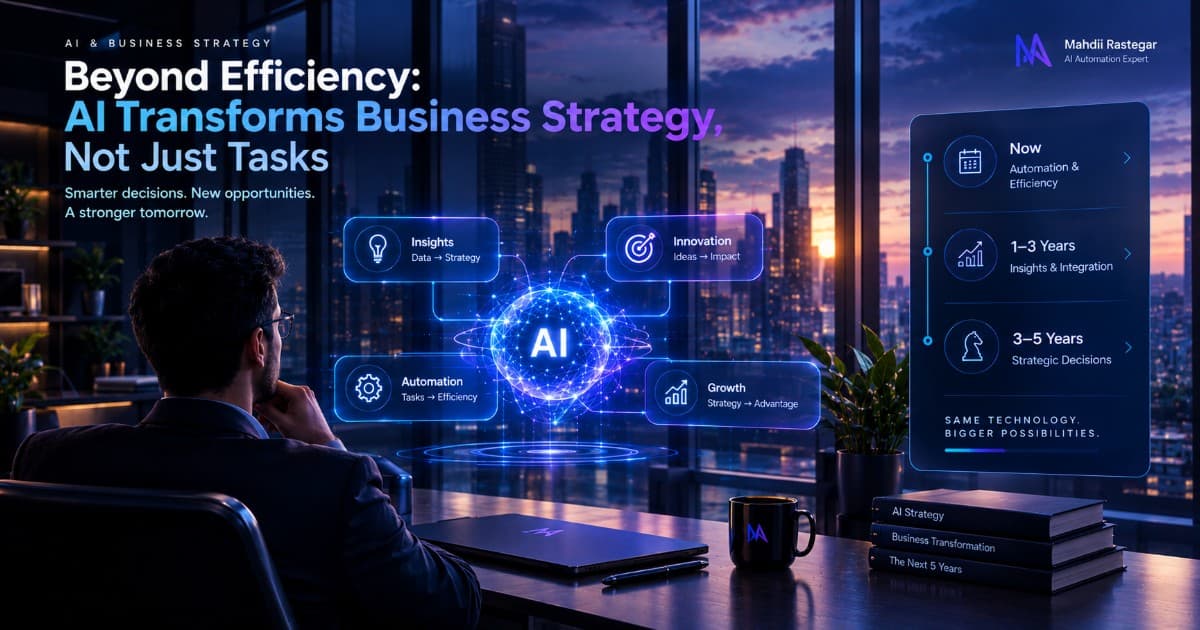
Many businesses initially view AI as a tool primarily for automating repetitive tasks and boosting operational efficiency. While AI certainly excels at streamlining operations, its true potential extends far beyond mere efficiency gains. The real value of AI lies in its ability to enable strategic decision-making, foster innovation, and reshape entire business models. This transformation frees human capital to focus on higher-level, creative work, allowing organizations to make meaningful decisions and pursue bold ideas.
The Strategic Shift: Moving Beyond Simple Task Automation
AI's foundational role in automating repetitive, rule-based processes is well-established. Tasks such as data entry, basic customer inquiries, or routine report generation can be handled by AI, leading to notable efficiency improvements. For instance, processes handled manually across several systems today can become controllable, traceable workflows with AI [company offering: Business Process Automation]. Similarly, AI Support Agents can manage initial customer interactions, answering repetitive questions and checking orders, thereby streamlining support operations.
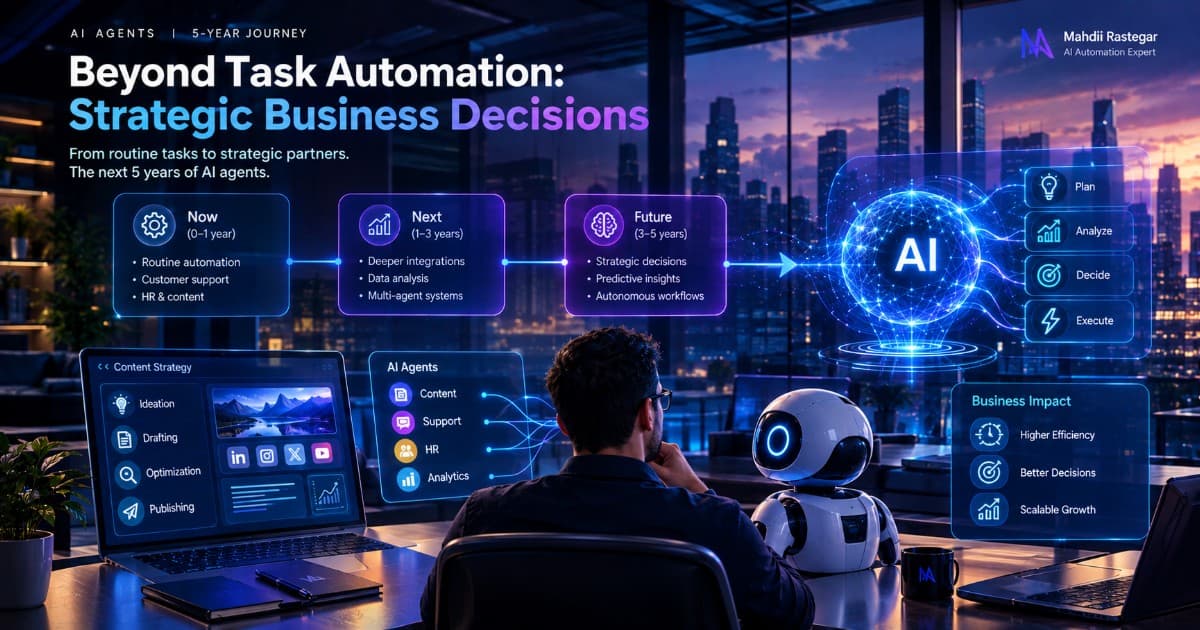
While efficiency is a significant benefit, it serves as a stepping stone rather than the ultimate goal. Over 82% of businesses see generative AI (genAI) as a primary lever for reinvention, with productivity being a key opportunity beyond operational efficiency2. As AI moves beyond experimentation, a broader shift towards enterprise-level reinvention of business and operating models will emerge2. Offloading routine tasks through AI creates capacity for employees to engage in more complex, strategic, and creative work. This shift redefines roles, allowing human potential within an organization to be optimized. Employees can redirect their efforts toward problem-solving, strategic planning, and innovative projects that require human insight and creativity.
From Data Overload to Strategic Insights: How AI Informs Decision-Making
AI's capability to process and analyze vast, complex datasets at a speed and scale beyond human capacity is central to its strategic value8. Traditional decision-making is often slow, reactive, and relies on ad-hoc analysis from overburdened data teams8. In contrast, sophisticated machine learning algorithms can analyze massive datasets related to industries, market conditions, and customer behavior to uncover hidden patterns and emerging trends3. This allows AI to turn raw data into clear, actionable intelligence, predicting trends and delivering real-time insights that drive faster, more strategic decisions8.
These AI-driven insights empower leaders to make more informed, data-backed strategic decisions. For example, an e-commerce company can leverage AI to analyze past sales data, search trends, web traffic metrics, pricing experiments, and customer reviews. This allows them to develop predictive models that forecast customer demand, identify high-growth products, and estimate optimal price points3. AI is perceived to gain traction in various domains of management, including investment evaluation, resource allocation, and performance management7. Predictive analytics, one of the most powerful applications of AI for business strategy, helps enhance forecasting and risk management3.
However, while AI can accelerate decision-making, it can also create a false sense of certainty5. Leaders need a disciplined approach, understanding what AI can and cannot do, and clarifying when human judgment is needed to maintain ethical awareness and accountability5. In an AI-powered workplace, teams must communicate outcomes clearly, and leaders must translate those results into sound, strategic decisions5. AI implementation touches strategy, operations, HR, and governance simultaneously, especially when AI-informed decisions impact consumers or employees5.
Fostering Innovation: AI as a Catalyst for Creativity and New Ideas
AI does not replace human creativity; instead, it liberates it by reducing the time spent on mundane administrative or analytical tasks5. This allows human experts to focus on generating and developing new ideas. AI can accelerate ideation by generating diverse options, simulating scenarios, or identifying gaps in existing solutions. The speed in generating and evaluating alternatives can be significantly increased by AI6. For instance, a company planning to launch a new product could use AI to generate and evaluate hundreds of potential product ideas, allowing managers to select from AI-recommended top ideas and significantly speed up the exploration of different options6.
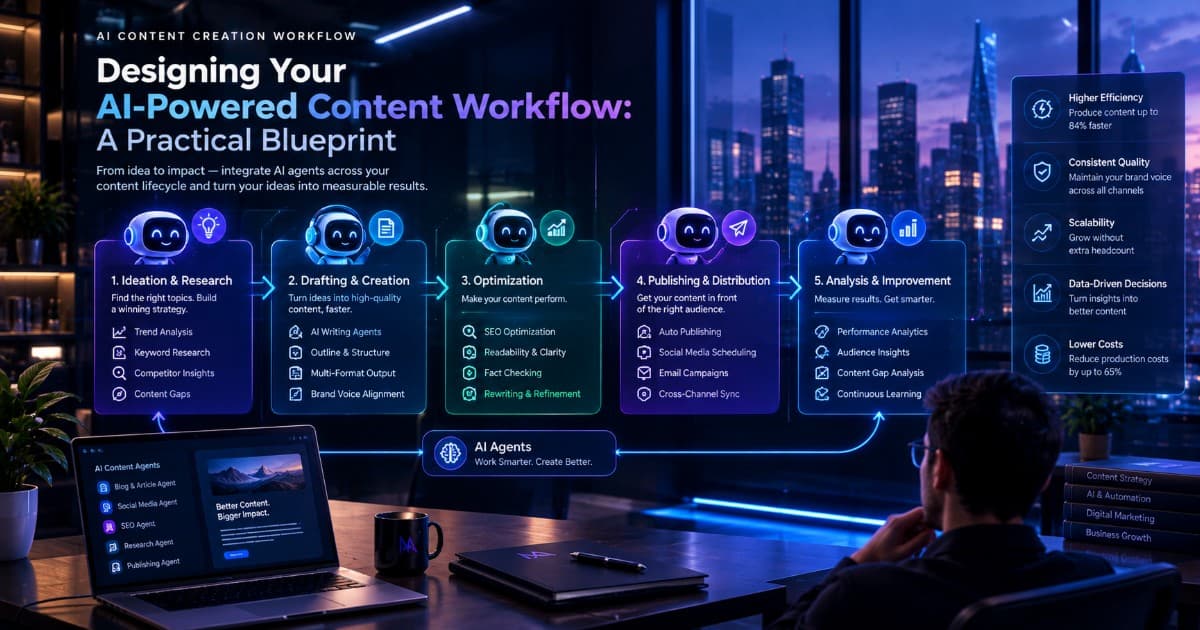
AI possesses key abilities required for Strategic Decision-Making (SDM)—generating and evaluating strategies—at a level comparable with humans participating in leading start-up accelerators and business plan competitions6. AI tools, such as AI Content Agents and AI Blog & Article Agents, can handle initial drafts, research, and content generation. This frees human experts to refine, innovate, and apply strategic oversight, ensuring brand consistency and creative direction.
AI also plays a critical role in enabling experimentation and rapid prototyping, leading to bold ideas and competitive advantage. The integration of AI and digital technologies are pivotal mechanisms for fostering business model innovation (BMI), enabling the development of new business models and the revitalization of existing ones10. AI generates new value creation and value capture pathways and enriches traditional ones10. New intermediaries and disintermediation powered by AI could disrupt incumbents while driving shifts in value dynamics and the development of emerging business ecosystems2. AI is instrumental in redefining the processes through which innovations are conceived and implemented10. For example, LiveCase transforms case studies into interactive simulations where learners talk to AI-powered characters, make choices under time pressure, and see consequences unfold in real time, teaching strategy through action12.
Practical Applications: Strategic AI in Action Across Business Functions
Strategic AI applications are transforming various business functions:
- Customer Experience: AI Support Agents move beyond basic FAQs to personalize interactions, predict customer needs, and proactively address issues. This frees human agents to focus on high-value problem-solving and complex cases, significantly impacting customer loyalty and brand perception. For example, Starbucks uses AI-driven personalization to deepen customer engagement and optimize store operations, which improves operational efficiency, reduces waste, and enhances customer satisfaction through consistent product availability11.
- Operations & Supply Chain: AI Workflow Automation and Reporting Automation optimize complex processes, identify bottlenecks, and enable proactive adjustments rather than reactive fixes. AI process automation minimizes delays, allowing organizations to capitalize on opportunities faster3. Starbucks's AI-driven inventory management, for instance, has minimized overstocking and shortages11.
- Human Resources: AI HR Agents and AI Recruitment Agents automate administrative tasks such as answering employee questions, managing leave requests, or screening resumes. This allows HR professionals to focus on talent development, strategic planning, and employee engagement, enhancing the overall employee experience.
- Marketing & Content: AI Content Agents and AI Blog & Article Agents streamline content production, from ideation and writing to SEO and publishing, while ensuring brand consistency across channels. This frees marketing teams to focus on campaign strategy, creative direction, and deeper customer engagement. Spotify's AI aids in personalized advertising, aligning ads with individual listening preferences to improve relevance and conversion rates. Its AI-driven features have significantly increased user engagement, with Discover Weekly listeners spending twice as much time on the platform11. Brands like Pizza Hut and PUMA are also reaping the benefits of AI-driven insights8.
Implementing Strategic AI: A Roadmap for Business Transformation
Implementing AI strategically begins with identifying core business objectives, not just tasks. This involves understanding how AI capabilities can contribute to competitive advantages that enable growth in existing markets or entry into new segments1. A phased approach is crucial, starting with pilot projects that demonstrate clear strategic value before scaling. Integrating AI solutions with existing systems and data infrastructure is also key to successful deployment.
Human-AI collaboration is essential, along with upskilling the workforce to leverage AI effectively. About 80% of both AI high performers and other respondents say their organizations are pursuing efficiency gains from AI, but high performers also have broader aspirations4. Organizations that successfully implement AI, like Zara, invest in data quality initiatives and foster cross-functional collaboration to ensure AI-driven decisions are effectively implemented11.
Measuring AI strategy success involves three metric categories: business impact (e.g., revenue growth, cost reduction), operational performance (e.g., project success rates, deployment speed), and strategic advancement (e.g., competitive positioning, AI maturity level)1. Competitive Positioning Improvements assess whether AI capabilities enhance an organization’s market position through differentiated offerings, superior operational performance, or innovative business models that competitors cannot easily match1. External expertise, such as Technical Consulting, can be invaluable in designing and implementing AI systems tailored to strategic goals, reviewing architecture, workflows, models, and performance to identify improvements.
Conclusion: Embracing AI for a Future of Strategic Advantage
AI is not merely a tool for achieving marginal gains; it is a fundamental driver of business strategy and innovation. By transforming how work is done, AI empowers organizations to move beyond simple task automation, enabling them to make meaningful decisions and pursue bold ideas. While efficiency is a welcome byproduct, the long-term strategic potential of AI lies in its capacity to unlock new insights, foster creativity, and redefine competitive advantage. Embracing AI strategically means looking beyond immediate operational improvements to envision a future where intelligent systems augment human capabilities and drive profound business transformation.
Your next intelligent business system could start here. To explore how strategic AI solutions can be tailored to your specific business needs and objectives, contact us today.